Legendary Women of Indian Mythology They chose. They questioned. They stood their ground.

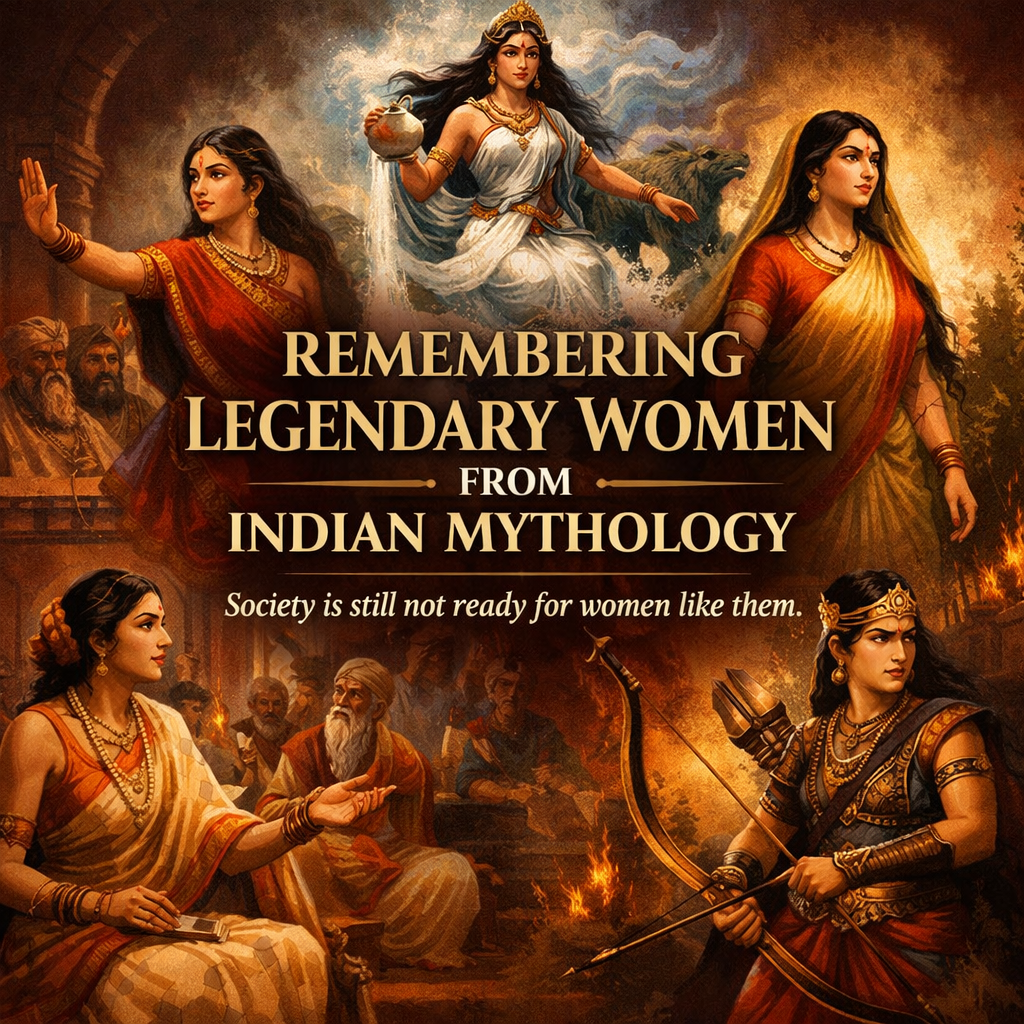
When we speak about women in Indian mythology, the conversation often revolves around sacrifice, devotion, and endurance. Their struggles are remembered, sometimes even glorified. But what is often overlooked is something far more powerful: their ability to choose.
These women were not merely symbols of patience. They made decisions. They set conditions. They questioned authority. They crossed lines, both literal and social, because they believed in their own judgment.
Take Ganga, for instance. When she agreed to marry King Shantanu, she did so on a clear condition: he would never question her actions. It was a boundary she set herself. When Shantanu finally broke that promise, Ganga did not argue, plead, or negotiate. She simply left. Her story is not about obedience or sacrifice; it is about a woman defining the terms of her own life.
Sita, too, is often remembered through the lens of suffering. Yet one of the most defining moments in her story is not her endurance but her decision-making. When Rama was exiled, Sita chose to accompany him to the forest despite being advised to stay back in the safety of the palace. Later, the act of crossing the Lakshman Rekha — often framed as a mistake — can also be seen as an assertion of agency. It was a choice she made on her own terms, guided by her sense of duty and compassion.
Then there is Draupadi, who refused to remain silent when she was humiliated in the Kaurava court. Surrounded by kings, elders, and warriors who looked away, she demanded answers. Her questions were direct and uncomfortable: Who had the right to gamble her away? In that moment, Draupadi did something radical — she challenged the authority of an entire court.
In the philosophical debates of the Vedic age, Gargi Vachaknavi stood in a royal assembly and questioned one of the most respected sages, Yajnavalkya. She did not ask simple questions; she challenged him on the nature of the universe and existence itself. Gargi’s presence in that court was a quiet but powerful declaration that intellectual courage was not limited by gender.
And the story of Amba, who later becomes Shikhandi, is perhaps one of the most striking acts of defiance in mythology. After being denied justice, Amba refused to accept her fate. Her determination to confront Bhishma eventually reshaped the course of the Mahabharata. In becoming Shikhandi, the story also disrupts rigid notions of identity and gender, showing how deeply the desire for justice can transform a life.
What connects these stories is not suffering — it is boldness.
These women made choices that unsettled the people around them. They questioned norms, set boundaries, and refused to quietly accept the roles assigned to them. Their stories remind us that agency is not always loud or dramatic. Sometimes it appears in the simple act of saying no, asking why, or choosing for oneself.
And perhaps that is why these figures still resonate today.
Because even now, society often celebrates women who endure, but struggles to accept women who decide.
On Women’s Day, remembering these legendary figures is not about glorifying their hardships. It is about recognising the courage it took for them to make choices in worlds that expected silence.
The truth is, Indian mythology has long imagined women who were bold, questioning, and fiercely independent.
The real question is whether society, even today, is ready for women like them.
Read Latest News and Breaking News at The Newsman, Browse for more Opinion News