O’Romeo Review: Shahid Kapoor, Triptii Dimri Powerfully Lead Vishal Bhardwaj’s Lyrical but Uneven Romance-Revenge Drama

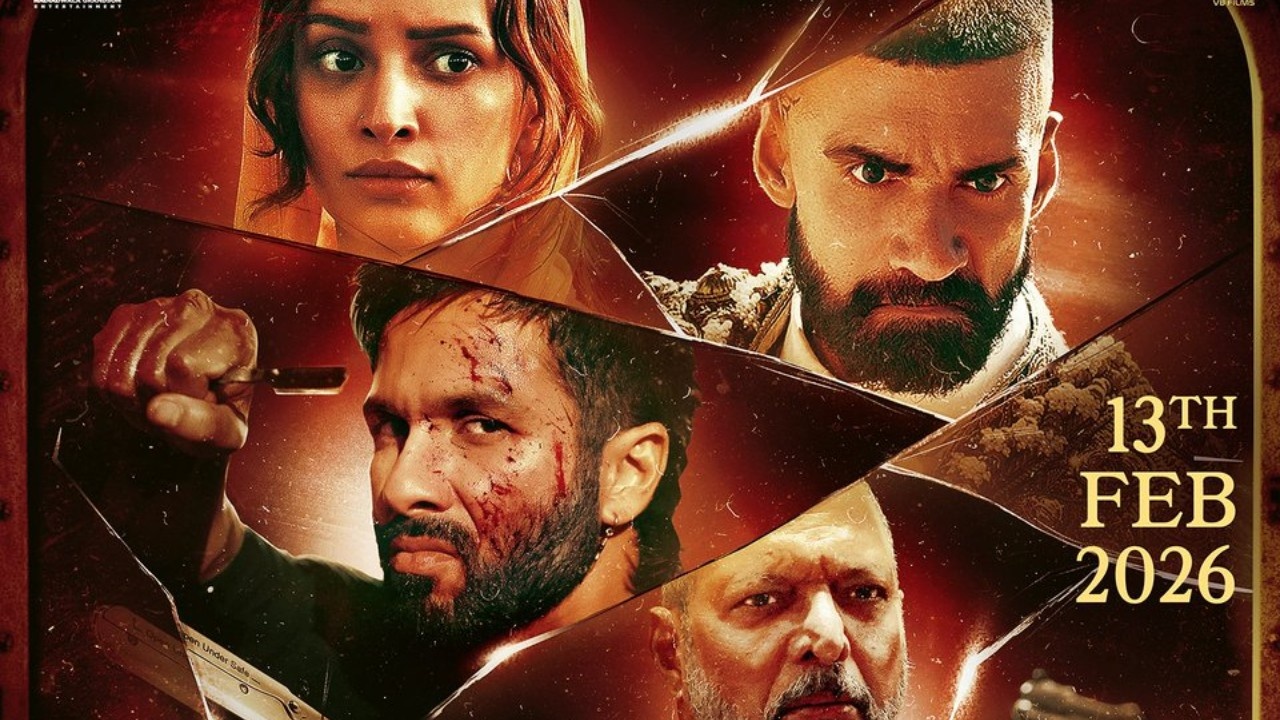
O’Romeo Review: A widow named Afsha walks into Ustara’s life with a list of men she wants erased from the world. On that list sits Jalal, the man who pulls the strings, makes the threats, and orders the bloodshed. What begins as a revenge drama slowly turns into something messier, hotter, and far more reckless. Love, rage and passion, everything spills together, and often it spills as blood.
Set in 1995 Mumbai, Vishal Bhardwaj’s O’Romeo opens on a pleasantly crazy note. The director introduces Shahid Kapoor’s Ustara with that signature flair only he can pull off – stylish, violent, oddly musical. There’s something almost theatrical about the way Ustara slices through men while an old Hindi tune plays in the background. Then enters Afsha, and it’s like the brazen playboy suddenly forgets he’s made of knives. Ustara softens, stumbles, and turns into this raw, confused loverboy. He becomes this accidental Romeo who kills not just out of duty, but out of some stubborn, all-consuming need to protect the woman who flipped his script.
O’Romeo Review: A Chemistry That Never Fully Erupts
But if there’s one thing about Bhardwaj’s cinema, it’s that he never tells a story straight. His films move like poetry, slipping through metaphors, going up against themes, and sometimes carefully withholding meaning so you’re forced to dig deeper into the visible. O’Romeo wants to be that kind of lyrical experience. And the core plot is intriguing; yet something in the execution wobbles.
For a film built on the idea of the passion of a man losing himself in love, I never fully felt the intensity between Ustara and Afsha. Yes, he kills for her and openly admits he’s in love. But beyond the dialogue and background songs, the heat never fully translates into lived emotion on screen. I kept waiting for that one moment where their chemistry punches through; sadly, it never truly arrives. Eventually, I accepted that there is something between them, some fire smouldering on both ends, but it takes far too long to come together, and even when it does, the impact is faint.
O’Romeo Review: Vishal Bhardwaj’s Signature Style Meets a Wobbly Execution
The non-linear narrative doesn’t help either. The screenplay stretches scenes beyond their natural life, and the rhythm Bhardwaj usually masters, the musicality of his storytelling, doesn’t feel in sync this time. The slower the film becomes, the more its flaws start flashing like red signals. Eventually, you start nitpicking as the screenplay gives you plenty to work with.
Even the film’s main villain fails to create the expected impact. Jalal, played by Avinash Tiwary, deserved better too. He is introduced as this monstrous force, and Avinash definitely tries to bring that menace alive. But the writing never gives him the aura he deserves. His threats feel performative, his presence diluted. Jalal should’ve been the kind of villain whose arrival feels like death knocking on the door, but the film spends so much time world-building and staging long fights that Jalal’s impact gets lost in the noise.
However, O’Romeo isn’t boring or unwatchable. Vishal’s film just constantly feels like a half-filled glass. As a viewer, if you are well-versed with his cinema, you see the ambition, the poetry, and the rhythm he is reaching for. But the story underneath isn’t rooted deeply enough in emotion or complexity to support that approach.
O’Romeo Review: Performances That Hold the Film Together
What does hold everything together are the performances. Shahid Kapoor, returning to Bhardwaj’s world after Kaminey, Haider, and Rangoon, once again taps into that deliciously unhinged space. As Ustara, Shahid is magnetic, he’s raging, unpredictable, and strangely tender. You like him almost instantly, even when he’s doing the absolute worst. On the other hand, Triptii Dimri gives one of her most layered performances yet. There’s both fragility and fire in her Afsha, the same duality she’s brought to films like Laila Majnu, Qala, and Bulbbul, but enriched here with sharper emotional textures. In his limited screen time, Nana Patekar consistently delivers a good performance, while Farida Jalal delivers a brutal and foul-mouthed act that is genuinely enjoyable to watch. Avinash Tiwary, despite the writing not fully supporting him, still leaves traces of the danger he’s capable of; you can see the potential even when the film doesn’t entirely use it.
But if there is one department where O’Romeo truly comes alive, it’s the music. Honestly, the background score does what the screenplay struggles to… it tells the story of desire, danger, and longing. Vishal Bhardwaj’s compositions, paired with Gulzar’s writing and Arijit Singh’s voice, carry a different kind of depth. There are scenes where the emotions land only because the music nudges them into place. Both “O’Romeo” and “Hum Toh Tere Hi Liye Hai” elevate the film; they build tension, they paint the unspoken, and they fill in the emotional blanks the film leaves open.
O’Romeo Review: Final Thoughts
Overall, O’Romeo feels like a film that had everything, the cast, the director, the mood, the music, but couldn’t quite merge it all into one immersive experience. It reaches for poetry but often ends up sounding like prose – thoughtful, ambitious, but not always effortless.
Read Latest News and Breaking News at The Newsman, Browse for more Entertainment News